The Basics of Celestial Navigation, Part 6: The Sun Clocked Out, but the Math Didn’t
Working a star sight and a planet sight through the same worksheet we used for the Sun.

- Introduction: why we want a backup to GPS
- Part 1: The math that makes the world go round
- Part 2: Turning sunshine into math (working a Sun sight)
- Part 3: Connecting the dots (plotting a running fix)
- Part 4: High noon, low math (latitude by noon sight)
- Part 5: Finding the second star on the right (identifying stars and planets)
- Part 6: The Sun clocked out, but the math didn’t (working star and planet sights) (you are here)
- Part 7: Three lines walk into a bar (plotting a three-body fix)
Once we have identified a star and measured its altitude, the work should look familiar. We are going to use the same worksheet as the Sun sight in Part 2. We still need the body's geographical position, the altitude we would expect at an assumed position, and the corrected altitude we measured. Comparing those last two numbers gives us an intercept.
The differences are mainly in the almanac. For a star, we begin with the GHA of Aries and add the star's sidereal hour angle, or SHA. We also leave out the Sun's lower-limb correction. A star is a point of light, so there is no edge to bring up to the center.
We will work Aldebaran all the way through, then use the same form for Saturn. The actual plotting belongs in Part 7.
The same worksheet
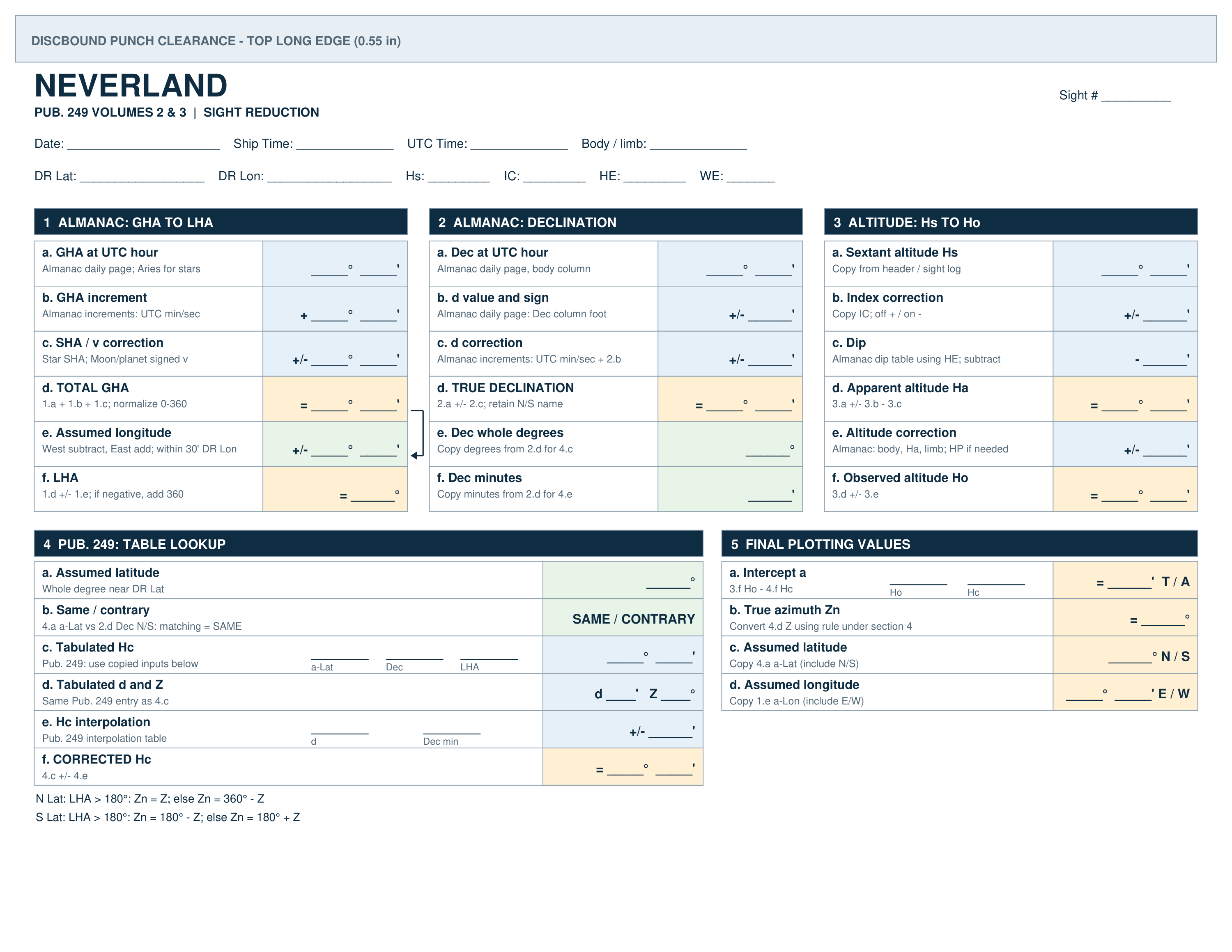
This is the same worksheet we used in Part 2. The SHA / v correction box in 1.c already gives us a place for a star's SHA. Some other fields will be marked not applicable for this sight.
The colors still help organize the work: blue mainly records values and lookups, yellow holds calculated results and final plotting values, and green holds inputs chosen or transferred for the tables. Follow the instruction in each field rather than assuming every blue number comes out of a book.
Our practice sight
We are using the stationary practice evening from Part 5: 10 January 2026, near 18°15.0′ N, 65°00.0′ W. Our star is Aldebaran. The sight time is 18:30:00 AST, or 22:30:00 UTC. The watch error is zero, index correction is 0.0′, and height of eye is 9 ft. The sextant reads Hs 45°52.9′.

Record the star's name as the body. There is no upper or lower limb to select. For a real sight, bring the star's point of light to the sea horizon, rock the sextant to establish the vertical angle, and record the UTC time at contact. Use the actual observation time for the almanac, not the time we originally planned to take the sight.
Start with Aries, not the Sun
Open the 10 January page of the supplied 2026 almanac. In 1.a, enter the GHA of Aries at 22h: 80°26.2′. Aries is our reference direction for locating the stars. We are not taking a sight of an object called Aries.


Now use the 30-minute increment panel from the back of the almanac at 00 seconds. Select the Aries column, not the Sun column. Its increment is 7°31.3′. Enter that in 1.b.
The GHA of Aries at the sight time is therefore:
80°26.2′ + 7°31.3′ = 87°57.5′.
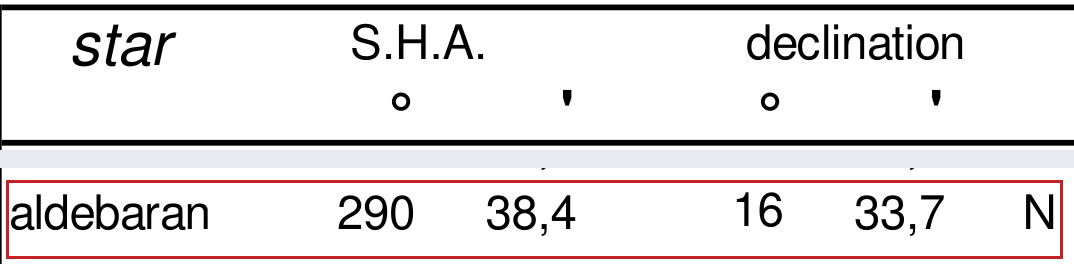
Find Aldebaran in the star list. Its SHA is 290°38.4′. This goes in 1.c. SHA is an angle measured westward from Aries to the star, so adding it moves us from the reference direction to the body we actually observed.
Add the three entries in section 1, then subtract 360° to keep the result within one circle:
1.d = 80°26.2′ + 7°31.3′ + 290°38.4′ = 378°35.9′ − 360° = 18°35.9′.
That is Aldebaran's GHA, not the GHA of Aries. Use the star's GHA for the remaining steps.
Declination is a shorter job this time
The same star entry gives declination 16°33.7′ N. Enter it in 2.a and copy it to 2.d. For this tabulated star sight, there is no hourly declination-rate correction to apply: mark 2.b and 2.c not applicable rather than borrowing the Sun's vd value.

The worksheet's 2.a label says “Dec at UTC hour,” but here we use the declination from the star entry valid for this almanac date. Split it into 16° in 2.e and 33.7′ in 2.f. As before, the whole degrees and minutes will be used at different stages of the Pub. 249 lookup.
Choose an assumed position
Use 18° N for assumed latitude. We want a nearby assumed longitude that produces a whole-degree LHA. At west longitude, subtract the assumed longitude from the body's GHA.
Choosing 64°35.9′ W gives:
1.f = 18°35.9′ − 64°35.9′ = −46°. Add 360° to obtain LHA 314°.

Enter 64°35.9′ W in 1.e, with the subtraction indicated, and 314° in 1.f. This longitude is 24.1′ east of our DR longitude, so it remains nearby. As in Part 2, the AP is a calculation reference, not a measured position.
Put 18° N in 4.a. Our latitude and Aldebaran's declination are both north, so 4.b is SAME. That is a change from the contrary-name Sun example.
Use the same volume of Pub. 249
We are continuing with Volume 2 and the same worksheet method, not switching to the Selected Stars tables in Volume 1. Open Volume 2 to printed page 111, PDF page 129. Select latitude 18°, declination SAME, the 16° declination column and LHA 314° on the right-hand side of the table.

Read Hc 46°04′, d +10′ and Z 85° from that entry. Enter Hc in 4.c and d and Z in 4.d. The d here describes the effect of changing declination on the computed altitude. It is not an hourly change in the star's declination.
Apply the declination minutes

We entered the table at declination 16°, but our star is at 16°33.7′. Open Table 5, printed page 248, PDF page 14. Use d magnitude 10′ and round the declination minutes to the nearest whole-minute column, 34′. Their intersection gives 6′. Since d is positive, enter +6′ in 4.e.
4.f = 46°04′ + 6′ = 46°10′.

This is the computed altitude at our AP. It has the whole-minute precision of this table procedure; writing additional decimal places would not create additional accuracy.
Correct the sextant reading
Copy Hs 45°52.9′ into 3.a and index correction 0.0′ into 3.b. At height of eye 9 ft (2.74 m), our dip correction is −2.9′, as in Part 2. Enter it in 3.c and apply it once:
3.d: Ha = 45°52.9′ + 0.0′ − 2.9′ = 45°50.0′.
Use the star refraction table of the almanac. Ha 45°50.0′ lies between 44°01′, which gives −1.0′, and 47°02′, which gives −0.9′. Interpolation rounds to −0.9′ at our working precision. Enter −0.9′ in 3.e.
3.f: Ho = 45°50.0′ − 0.9′ = 45°49.1′.
The important difference from our Sun sight is that a star has no semidiameter correction. We are observing a point of light, not the lower edge of a disk. For an ordinary star sight, after index and dip corrections, the remaining altitude correction is atmospheric refraction. Don't carry over January's +16.3′ Sun correction just because it was in the last worksheet.
The dip is still subtracted once. If we record it as a signed negative correction, add that negative number; do not subtract the negative a second time. Watch this one: the worksheet’s 3.d line says to subtract 3.c, so if you’ve written dip as −2.9′, subtracting it again would add it.
Check the star correction tables


Collect the plotting values
The observed altitude is 45°49.1′ and the corrected computed altitude is 46°10′. Subtract:
5.a: Ho − Hc = 45°49.1′ − 46°10.0′ = −20.9′.
Record 20.9 nautical miles AWAY. Hc is greater than Ho, so the line lies away from the star’s geographical position. An intercept of this size does not mean our practice position is twenty miles wrong: it measures the separation from the chosen AP’s computed line, not from the DR position.

Our assumed latitude is north and LHA is greater than 180°, so the worksheet's rule gives Zn = Z = 85° true. Copy the AP into 5.c and 5.d. Keep the intercept's magnitude and Toward or Away label together.
That finishes the sight reduction. We have the information for one line of position. It does not give us a complete fix on its own. In Part 7, we will use this sight with Saturn and Alpheratz from the same stationary practice session. A real moving boat would need its movement accounted for before comparing lines from different times.
Now do the same thing for Saturn
Two minutes later, our simulated observer takes a sight of Saturn. We are still stationary. The time is 22:32:00 UTC, or 18:32:00 AST, and the sextant reading is 56°57.5′. Height of eye, index correction and watch error are unchanged.
We can use the same worksheet. The main difference is where the numbers come from. A star uses Aries plus SHA. A planet has its own hourly GHA and declination.

Start with Saturn's own GHA

In the almanac, find 10 January and the Saturn column. At 22h, GHA is 82°28.2′. This goes in 1.a. The Sun/Planets increment for 32m 00s is 8°00.0′, which goes in 1.b.
The planet's v correction

The daily page gives Saturn v = +2.3′. That is the hourly correction rate, not the correction we enter directly in the worksheet. In the 32-minute correction panel, the 2.3 rate gives 1.2′. Apply it positively in 1.c. There is no SHA to add for Saturn.
1.d = 82°28.2′ + 8°00.0′ + 1.2′ = 90°29.4′.

Declination and the assumed position
Saturn's 22h declination is S 3°18.5′. Its d rate is 0.1′ per hour, and the surrounding hourly entries show that the south declination is decreasing. The 32-minute correction table gives 0.1′, so subtract that from the southern magnitude:
2.d = S 3°18.5′ − 0.1′ = S 3°18.4′.

This daily-almanac d is not the Pub. 249 d that we will use shortly. One changes declination with time; the other adjusts computed altitude for declination minutes. The repeated letter is unfortunate, but the boxes keep the jobs separate.

Choose AP latitude 18° N and longitude 65°29.4′ W. As before, this is a convenient calculation point, not a new estimate of where we are. Its longitude makes LHA a whole number:
1.f = 90°29.4′ − 65°29.4′ = 25°.
Look up Saturn's computed altitude

Our AP is north and Saturn's declination is south, so use CONTRARY. In Pub. 249 Volume 2, find latitude 18°, LHA 25°, and declination 3°. The entries are Hc 57°38′, d −40′, and Z 128°.

For Table 5, round the declination remainder 18.4′ to 18′ at this table's whole-minute precision. On PDF page 14, printed page 248, d magnitude 40 and 18 minutes give 12′. Pub. 249's d is negative, so subtract:
4.f = 57°38′ − 12′ = 57°26′.
Finish Saturn's altitude correction

Now return to our simulated sextant reading. Apply index correction and dip exactly as we did for Aldebaran:
3.d: Ha = 56°57.5′ + 0.0′ − 2.9′ = 56°54.6′.

For Saturn, use the Stars & Planets correction table in the 2026 Nautical Almanac. Ha falls in the 56°09′ to 60°26′ band, which gives −0.6′. We are not using the Sun's lower-limb correction or adding a star-table correction on top of this one.
3.f: Ho = 56°54.6′ − 0.6′ = 56°54.0′.
Saturn's plotting values

Subtract the corrected computed altitude from Ho:
5.a: 56°54.0′ − 57°26.0′ = −32.0′, or 32.0 nautical miles AWAY.

Our assumed latitude is north and LHA is less than 180°. Use Zn = 360° − Z, giving 360° − 128° = 232° true.
That is the second reduction finished. It follows the same path through the worksheet, but uses Saturn's own GHA, a v correction instead of SHA, and a time adjustment to declination.
What we will carry into the plot
We now have a worked star sight and a worked planet sight. Our third simulated sight, Alpheratz at 22:34 UTC, follows the star procedure used for Aldebaran. Its plotting values are 31.4 nautical miles Toward, Zn 303° true, from AP 18° N, 64°31.6′ W. Part 7 will bring those three lines together on the plotting sheet.
None of these reductions is a fix by itself. We have deliberately kept the observer stationary so that the next step can concentrate on the geometry. On a moving boat, sights taken at different times need to be brought to a common time before their lines are compared.
Next in the series: Part 7: Three lines walk into a bar (plotting a three-body fix)