Building Neverland
Follow Neverland, the first Vision 484, from her first wooden framework to the paint shop. Our ongoing build journal includes photos and videos from every stage.
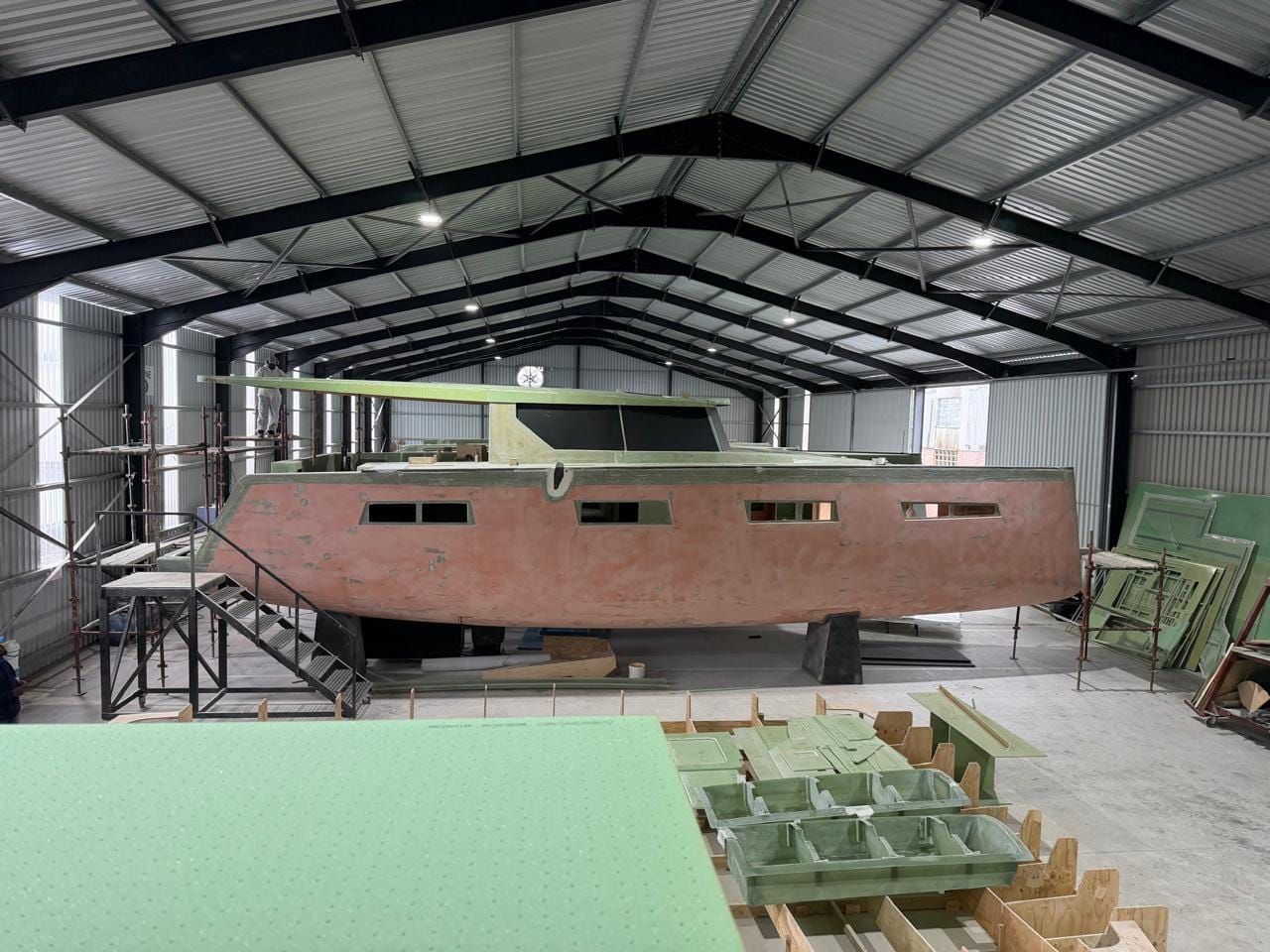
From the first framework to the paint shop.
The build starts
Neverland started with some lumber on a factory floor. It is a funny beginning for something we plan to sail across an ocean and call home, but looking back through these photos, that is one of my favorite parts. We have been able to watch her become a boat, piece by piece.
She is the first Vision 484, being built by Vision Yachts in Knysna, South Africa. Being hull number one means getting to see a new design come to life, including the decisions and changes that happen along the way. Kelly and I wanted to keep a record of that process. This is the story so far, and we will keep adding to it as the build continues.
I happened to be in Knysna preparing for my Atlantic crossing aboard Unlimited when work officially began on Neverland. I got to see the new factory floor where the 484s would be built and stand there on day one. At that point, imagining the finished boat required a fairly generous amount of imagination.
Because the 484 was a new design without an existing set of molds, the team began by building a wooden framework to form the hulls around. Neverland uses epoxy resin and a foam core, a change from the vinyl ester construction used for the 444. The aim is a light, strong structure. In those first pictures, though, the most recognizable building material was still the timber holding everything in place.
Before long, those empty outlines would be the hulls carrying our home. Getting to see where that started was pretty special.
Early progress
The early updates were wonderfully satisfying. James and the factory team were turning an outline into something recognizable, and every new batch of pictures seemed to contain a big change. A shape on the floor became a hull. Then there were two hulls. Then they came together, and suddenly we could see the width and scale of the boat we had been talking about for so long.
The photos make it easy to appreciate the work involved. There are temporary supports, scaffolding, bare composite surfaces, and people working around a structure that looks enormous inside the building. The boat is still a long way from being finished, but her basic shape is there.
One of the pleasures of being hull number one has been how excited the team is about the project. We get plenty of progress pictures, and it feels like everyone wants to share what has changed. That makes a big difference when we are following most of the build from another continent.
This is the stage where progress is easy to spot even if you know very little about boatbuilding. Put two photos next to each other and the difference is obvious. Watching the hulls come together was one of those milestones that made the whole thing feel much more real. There was a boat in that building, and she was ours.
Middle progress
Eventually the updates became less dramatic from the outside. The hulls were there, and the big changes in silhouette gave way to work inside. There was still plenty happening, but it took a closer look to understand it. This was when a boat shell began to turn into the spaces we will actually live in.
It has also been one of the slower parts of the process. The 444s moving through the factory have an established design and build sequence. With the first 484, some things need to be worked through at full size. James has a clear vision for the boat, but a drawing or computer rendering can only tell you so much. Standing in the space lets you see how it feels and how it could work better.
That has led to changes such as walk-through closets in the port forward cabin, a large cabinet in the workshop area, and a redesign of the salon seating. Each change takes time. There are ideas to explore, prototypes to consider, and decisions to make before the team can move on.
We would obviously love everything to happen quickly. But these are spaces we expect to use every day for years, so there is real value in taking the time now. You can see the family resemblance to the 444, but the 484 is developing into a design of her own. The extra space needs to make sense for this boat and the way she will be used.
The coachroof goes on
Then came another milestone that needed no explanation: the coachroof went on.
Thankfully, the factory team filmed the operation. Watching a piece that large being lifted into position is much more interesting than simply receiving an after photo. There is a lot of careful work between having a roof sitting beside the boat and having it exactly where it belongs.
It made an enormous difference to how Neverland looked. The spaces underneath gained a ceiling, and the side profile finally showed the lines we had been waiting to see. She looked much closer to the finished boat we had been picturing.
One of the changes we particularly like is how far aft the roof extends, all the way back toward the sugarscoops, the steps at the stern of each hull. On the 444, that area had supports for solar panels. The extended roof gives the 484 a much more substantial area above the stern, with room to work and, eventually, jump off the back of the boat.
There will be plenty of practical details to appreciate once we are aboard, but at this point I was mostly enjoying the view. That long roofline just looks good. Even sitting on supports in a factory, she looks like she wants to get moving.
Back in Knysna
At the beginning of September 2026, I went back to Knysna to check on the build and spend time with the team. It is a long flight, but it was absolutely worth it. Besides, an excuse to spend time in Knysna is usually worth taking.
Tommy and Amy graciously let me stay with them again. Their house had somehow become even more gorgeous since our previous visit. It is a very nice place to recover from the trip and a dangerous place to develop expectations about your own future living space.
By then, much of Neverland’s structure was in place. There was still plenty of work ahead, but I could walk through the boat and understand the spaces in a way that photos never quite allow. I spent time with James, Thomas, and the team discussing the design details, the choices already made, and the options still open.
That is something we have really appreciated about Vision. They are a production boat company, but the experience has felt personal. James comes from a background in fully custom boats, and there is a willingness to work through ideas with owners rather than simply point to an options list.
Sometimes that means trying something new. Sometimes it means explaining why the boat was designed a certain way and why my brilliant idea might be less brilliant in practice. I appreciate both. Being willing to explore an idea matters, but so does being candid enough to keep us out of trouble.
The big move
I had been there for the first timber framework. As luck would have it, I was also there when Neverland left the lower factory and moved up the street to Vision’s main campus.
It was a short journey, but it was quite a production. Inside a factory, you get used to seeing a big boat surrounded by other big things. Put that same boat in a driveway and then on a road, and her size becomes much harder to ignore.
The driver’s skill was incredible. Watching him maneuver Neverland through the tight driveway and up the street gave me a healthy appreciation for a job I was very happy someone else was doing. There was not a lot of room for casual steering.
What made the day even better was how many people from Vision came out to watch and help mark the occasion. The move turned into a bit of a parade. It was not just the people whose jobs directly involved getting the boat from one building to the other. Johann was there from the finance side, looking every bit as excited as I was.
They did not have to come out. That is what stuck with me. We are understandably invested in this boat, but seeing that same enthusiasm from the people building her means a lot. Neverland has our name on the paperwork, but there are a lot of people who have put something of themselves into getting her this far.
Into painting
Once Neverland reached the main factory, the next stage was getting her into position for painting. That sounds straightforward until you discover that the building needs a few alterations first.
To make room for her, the team removed part of the rear walkway. They also cut two small openings in the back wall so the davits could fit through. Apparently, sometimes building a bigger boat means doing a little construction on the factory as well.
Again, someone made sure to film the process so we could follow along. We have really appreciated that throughout the build. These moments are easy to miss from a distance, and the pictures and videos have let us feel involved even when we cannot be there.
The photos from this stage show a different sort of transformation starting. The raw composite spaces are becoming lighter as surfaces are prepared and coated, and it is easier to imagine what they will look like finished. We are especially looking forward to seeing her in her new colors. After so many months of green composite and pink fairing, lavender will be quite a change.
That is where the story stands for now. There is more finishing and fitting out ahead before launch, and we will keep adding to this journal as Neverland progresses. For the moment, we are enjoying looking back at how far she has come: from a few pieces of timber on the floor to a boat big enough to require changes to the building. We cannot wait to see what comes next.